
Our Latest Thinking, Insights and Updates
Warehouse Robotics Strategy in APAC: Adoption & Suppliers
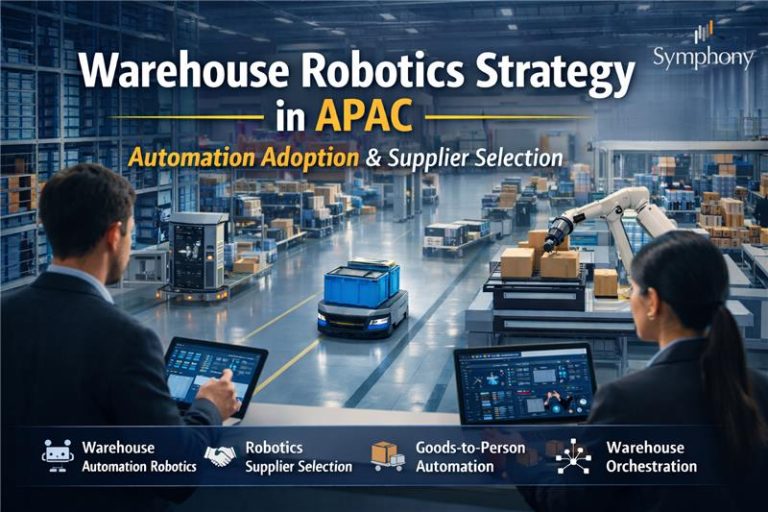
Warehouse Robotics Strategy in APAC: Automation Adoption and Supplier Selection
Warehouse automation in the Asia-Pacific (APAC) region has reached a strategic inflection point. What began as a response to labor shortages has evolved into a broader transformation agenda focused on resilience, scalability, throughput predictability, and long-term cost efficiency. As a result, warehouse robotics strategy is now a priority topic for logistics leaders and CIOs.
Rather than asking whether to automate, organizations are increasingly focused on how to adopt robotics sustainably, which technologies best fit their operating models, and how to select robotics suppliers in a market that is expanding rapidly and diversifying across regions.
This article examines the warehouse automation robotics landscape in APAC, outlines a practical framework for robotics supplier selection, and explains why warehouse automation orchestration has become essential in modern, multi-vendor automated warehouses.
The Warehouse Automation Robotics Landscape in APAC
APAC has emerged as one of the fastest-growing regions for warehouse robotics adoption. Growth in e-commerce, omnichannel fulfillment, urban logistics, and rising labor costs has accelerated investment across China, Japan, Southeast Asia, and Australia.
Unlike earlier automation waves dominated by fixed conveyors and highly customized systems, today’s warehouses increasingly adopt modular, software-driven robotics. These solutions enable incremental automation, faster deployment, and greater flexibility—an important advantage in APAC markets where demand volatility and space constraints are common.
Key technology categories shaping the region include:
- Autonomous Mobile Robots (AMRs)
- Automated Storage and Retrieval Systems (ASRS)
- Goods-to-person automation
- Vertical Lift Modules (VLMs)
- Robotics-assisted picking and sortation
Together, these technologies form the foundation of modern warehouse automation strategies.
Core Robotics Technologies in Modern Warehouses
Autonomous Mobile Robots (AMRs)
AMRs play a central role in contemporary warehouse automation robotics strategies. Unlike traditional AGVs, AMRs navigate dynamically and can be redeployed as layouts or workflows change. They are widely used for goods-to-person picking, tote movement, replenishment, and pallet transport. AMRs are particularly effective in:
- E-commerce and omnichannel fulfillment
- 3PL and contract logistics operations
- Medium to large warehouses requiring flexibility and scalability
The modular design allows organizations to increase capacity by adding robots without the need to redesign the infrastructure.
ASRS and Shuttle-Based Automation
ASRS solutions provide high throughput and dense storage by automating putaway and retrieval within fixed structures. Shuttle-based ASRS systems are commonly deployed in high-volume distribution centers where speed and predictability are critical. While ASRS delivers strong performance, it typically requires higher upfront investment and long-term commitment to facility design, making it most suitable for stable, high-volume operations.
Goods-to-Person Automation
Goods-to-person automation reduces operator travel by bringing inventory directly to picking stations. Both AMRs and ASRS can support this model, which has become a cornerstone of modern fulfillment strategies. It is especially effective in:
- Environment with a high number of SKUs
- Small order picking with high frequency
- Operations with limited workforce
Vertical Lift Modules (VLMs)
VLMs optimize vertical space and are widely used in spare parts, manufacturing, pharmaceutical, and MRO warehouses. They complement broader automation strategies by efficiently handling slow-moving, high-value, or space-sensitive inventory.
Major Robotics Providers in the APAC Market
The APAC robotics ecosystem includes a diverse mix of regional innovators and established global suppliers, each with different strengths and sector focus.
Chinese Robotics Providers: Speed and Scale
- Geek+ – AMRs and goods-to-person solutions for e-commerce, retail, and 3PL environments
- Hikrobot – Vision-enabled AMRs and AGVs with strong manufacturing logistics roots
- Quicktron – High-density AMRs and robotic forklifts for large fulfillment centers
- Libiao Robotics – Swarm-based sorting robots used extensively in parcel and e-commerce logistics
These providers are known for rapid innovation cycles, competitive pricing, and large-scale deployments. However, organizations should carefully evaluate long-term support models, integration governance, and roadmap stability.
Japanese and European Providers: Reliability and Engineering Depth
- Omron – AMRs and industrial automation with strong emphasis on safety and reliability
- KUKA – Industrial robotics and integrated automation for complex warehouse environments
- Modula – VLM-based goods-to-person storage for space-optimized operations
These vendors typically focus on system robustness, compliance, and lifecycle stability, often with a higher cost structure.
Robotics Supplier Selection: A Strategic Framework
1. Technology Maturity and Sector Alignment
Proven deployments in similar operational environments reduce execution risk. Sector experience—such as e-commerce, manufacturing, cold chain, or pharmaceuticals—is often as important as technical capability.
2. Integration and System Compatibility
Robotics solutions must integrate seamlessly with WMS, ERP, and other execution systems. Open APIs, event-driven interfaces, and proven integration patterns are essential, especially in multi-vendor environments. Meskipun ASRS memberikan kinerja yang kuat, sistem ini biasanya membutuhkan investasi awal yang lebih besar dan komitmen jangka panjang terhadap desain fasilitas, sehingga paling cocok untuk operasi yang stabil dan bervolume tinggi.
3. Scalability and Flexibility
Warehouses evolve. Solutions should allow additional robots, storage capacity, or workflow changes without major disruption—an important consideration for APAC operations facing fluctuating demand.
4. Total Cost of Ownership
Beyond upfront investment, organizations must consider:
- Integration and customization effort
- Software licensing and upgrades
- Maintenance and support
- Operational overhead and expansion costs
Flexible commercial models such as robotics-as-a-service may reduce initial risk but should be evaluated over the full lifecycle.
5. Regional Support and Service Capability
Local engineering support, response times, and spare parts availability directly impact operational continuity. In APAC, regional presence is often a decisive factor.
The Role of Warehouse Automation Orchestration
As warehouses deploy multiple robotics technologies, coordination becomes a critical challenge. Robotics vendors typically optimize their own systems, but modern warehouses require warehouse automation orchestration to align tasks, priorities, and workflows across all automation assets.
An effective orchestration layer:
- Separates warehouse execution logic from device-specific control
- Enables multi-vendor automation environments
- Improves throughput predictability and system resilience
- Simplifies exception handling and recovery
- Reduces vendor lock-in over time
Without orchestration, automation risks becoming fragmented, creating new bottlenecks rather than eliminating existing ones.
Strategic Takeaways for Logistics Leaders and CIOs
- Warehouse robotics strategy should begin with business objectives, not technology preferences
- No single robotics vendor fits all sectors or operational models
- Integration and orchestration are as critical as robot performance
- Long-term scalability and governance outweigh short-term cost savings
- A phased, data-driven adoption approach reduces risk and improves ROI
Conclusion
Warehouse robotics adoption in APAC is no longer experimental—it is strategic. As automation becomes central to warehouse performance, organizations must move beyond isolated robotics projects toward cohesive, orchestrated automation strategies.
By aligning warehouse automation robotics investments with operational realities, applying a structured robotics supplier selection framework, and embracing warehouse automation orchestration, logistics leaders can build resilient, scalable, and future-ready warehouse operations.
If you’d like to explore this further, you can learn more about how these capabilities come together in the Symphony Logistics Suite.