
Our Latest Thinking, Insights and Updates
eCommerce WMS & Automation Integration
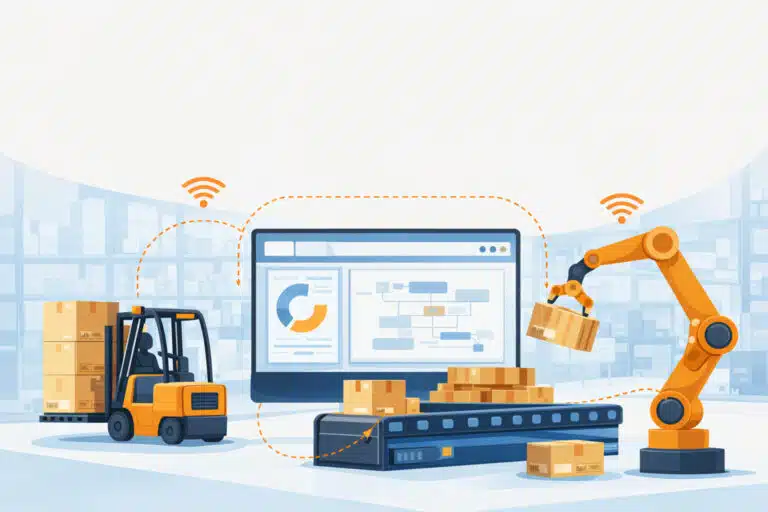
eCommerce Warehouse Management: Why Your WMS and Automation Must Work as One
eCommerce warehouse operations are increasingly automated. Pick-to-light systems, mobile robots, and automated storage solutions are now common across fulfilment centres of all sizes.
Yet many operations that have invested heavily in automation still face the same problems: manual intervention at peak periods, inconsistent throughput, and exceptions that require staff to step in and override the system.
The root cause is rarely the automation equipment itself. It is the absence of a warehouse management system designed to direct it.
In eCommerce fulfilment, WMS capability and automation integration are not separate decisions. Together, they determine whether a warehouse can execute at scale — or simply move faster while making the same mistakes.
The Operational Reality of eCommerce Fulfilment
eCommerce warehouses process orders that are fundamentally different from conventional fulfilment. The characteristics that define this environment create specific demands on both the WMS and automation layer.
Unlike traditional warehouses, eCommerce operations must manage:
- High volumes of individual, single-unit orders
- Multi-channel demand with different SLA requirements per channel
- Frequent SKU changes and fast merchant onboarding
- Unpredictable demand spikes from promotions and flash sales
- Continuous decision-making across every order, every hour
These conditions make manual task management impractical at scale. They also expose the limits of automation systems that operate without a coordinating intelligence layer.
What Happens During a Flash Sale
Consider a common eCommerce scenario: a promotional campaign launches at midday and order volume triples within two hours.
In a warehouse where the WMS and automation systems are not integrated, the sequence of events is predictable. AMRs complete their current task queues and wait for new instructions that are slow to arrive. Pick-to-light zones are assigned manually by supervisors who do not have a real-time view of which zones are congested and which are idle. Conveyors begin to back up as inbound picking outpaces sortation capacity. Exceptions — wrong items, unavailable stock, carrier label failures — pile up in a manual queue because no system is routing them automatically.
By the time throughput is restored, SLA windows for the first wave of orders have passed.
In an integrated environment, the WMS detects the volume surge in real time. It rebalances task allocation across all automation systems simultaneously, prioritises orders by carrier cut-off, and routes exceptions automatically without supervisor intervention. Throughput scales with demand rather than against it.
The difference is not the automation. It is the intelligence directing it.
The WMS as the Control Layer — Not Just a Record Keeper
In conventional warehousing, a WMS is often used primarily to track inventory and record transactions. In eCommerce, this is not sufficient.
An eCommerce WMS must function as an active control layer — making execution decisions in real time, across every order, without human input at each step.
Effective eCommerce WMS control requires:
- Dynamic order allocation based on stock, SLA, and fulfilment node availability
- System-directed task assignment to operators and automation systems
- Real-time exception detection and automatic reallocation
- Multi-channel inventory synchronisation to prevent oversells
- Per-seller fulfilment logic for marketplace and multi-merchant operations
Without this level of control, warehouses rely on supervisors and operators to make decisions that should be handled by the system. At high order volumes, that reliance becomes a constraint on throughput and accuracy.
The Integration Layer: WMS, WCS, and Automation Equipment
A common misconception is that WMS-to-automation integration is a direct connection — the WMS sends an instruction and the equipment acts on it. In practice, the integration architecture is more layered.
Most automation environments include a Warehouse Control System (WCS) or Material Flow Controller (MFC) that sits between the WMS and the physical equipment. The WCS manages real-time equipment-level signals — conveyor speeds, robot task queues, sortation logic — while the WMS manages order-level decisions and task prioritisation.
Understanding this distinction matters for three reasons:
- Integration scope — connecting a WMS to an automation environment requires interfaces at both the WCS and equipment level, not just a single API connection
- Responsibility boundaries — the WMS governs what needs to happen; the WCS governs how the equipment executes it
- Exception ownership — when a robot fails or a conveyor jams, the WCS manages the equipment response while the WMS manages the order impact
Operations that treat WMS and automation integration as a single-layer problem typically underestimate implementation scope. Recognising the WCS as a distinct layer leads to more accurate project planning and more robust operational outcomes.
System-Directed Picking as the Integration Point
System-directed picking is where WMS and automation integration becomes most visible in daily operations. It is the mechanism through which the WMS controls what gets picked, by whom or what system, and in what sequence.
In an integrated environment, system-directed picking enables:
- Optimised pick paths based on order priority and zone layout
- Dynamic task routing between operators and automation systems
- Real-time reallocation when a robot or conveyor is unavailable
- Batch and wave management aligned to carrier cut-off times
- Accuracy enforcement through scan validation at each pick step
Industry data consistently shows that WMS-directed picking achieves pick accuracy rates above 99.5 percent. Manual and semi-directed operations typically range between 98 and 99 percent. At 10,000 orders per day, that difference represents hundreds of incorrect picks — each generating a return, a customer complaint, or a re-ship cost.
Without system-directed picking, operators and automation systems make local decisions that may be individually efficient but collectively suboptimal. The WMS resolves this by coordinating the entire operation from a single execution layer.
Orchestrating Multiple Automation Systems
Most eCommerce fulfilment operations use more than one automation system. A typical environment may include pick-to-light (PTL), autonomous mobile robots (AMR), automated storage and retrieval systems (ASRS), conveyors, and vertical lift modules (VLM).
When each system operates independently, the warehouse has multiple automation layers with no shared logic. Staff manage the gaps between them manually.
WMS-driven orchestration across automation systems ensures:
- Single execution signal governing all automation simultaneously
- Automatic work redistribution when any system reaches capacity
- Unified exception management across all automation layers
- Real-time throughput visibility from one operational view
- Scalable response to volume spikes without manual rebalancing
The practical outcome is a warehouse where automation systems act as one coordinated layer — not as separate tools that happen to share the same floor.
Signals That a WMS-Automation Gap Exists
Not every operation will immediately recognise the gap between their WMS and automation systems. The following operational signals typically indicate that integration is insufficient:
- Throughput plateaus despite additional automation investment
- Rising supervisor-to-operator ratios as exception management grows
- Manual rebalancing required during every peak period
- No single real-time view of performance across all automation systems
- Increasing pick error rates as order volume scales
These are not equipment problems. They are symptoms of an execution layer that has not kept pace with the automation investment beneath it.
From Capability to Business Impact
When a purpose-built eCommerce WMS and automation systems are integrated through a unified control layer, the operational impact is direct and measurable:
- Pick accuracy above 99.5 percent through system-enforced task direction
- Increased throughput without proportional headcount growth
- Increased throughput without proportional headcount growth
- Reduced exception handling and supervisor intervention
- Lower cost per order as automation operates at designed capacity
These outcomes are particularly significant during promotional periods and flash sales, where order volume can multiply rapidly. A disconnected WMS and automation environment typically degrades at exactly this moment. An integrated one scales to meet it.
Conclusion
eCommerce warehouse management and automation are not separate investments. One without the other produces partial results.
Automation without WMS direction moves faster but not smarter. A WMS without automation integration controls data but cannot execute at the speed eCommerce requires.
Together — with the WMS acting as the control layer, the WCS managing equipment execution, and automation systems operating under unified direction — they form the operational foundation that eCommerce fulfilment at scale demands.
Organisations that treat WMS capability and automation integration as a single decision, rather than two separate projects, are better positioned to deliver consistent fulfilment performance as their eCommerce operations grow.
Learn more: boonsoftware.com/ecommerce/