
Our Latest Thinking, Insights and Updates
From Automated to Autonomous Warehouses
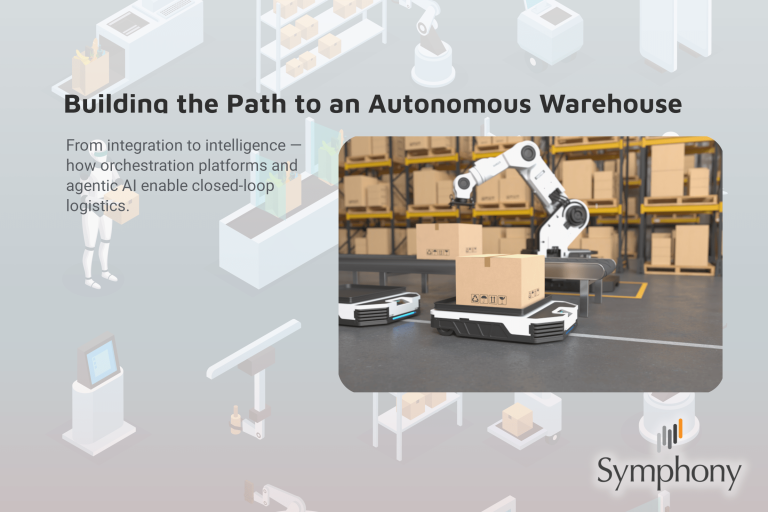
The Next Leap in Logistics Innovation
Warehouses are no longer just about moving boxes — they’re becoming intelligent, connected ecosystems. For years, logistics innovation centered around automation: using machines and software to execute predefined, repetitive tasks. Today, the focus is shifting toward autonomy — creating a warehouse that can perceive, decide, and act on its own.
This evolution moves beyond isolated robots and conveyor belts to a connected, policy-aware warehouse environment that continuously learns and adapts. The question now is — how do we get there, and which technologies make it possible?
The Three Stages of Warehouse Evolution
Understanding this journey requires a clear view of how warehouse technology has matured over time:
Stage 1: The Automated Warehouse
Defined by rule-based systems executing specific commands — ranging from conveyor belts and AS/RS systems to early-generation robots. These solutions deliver high efficiency, but remain siloed and focused on specific tasks.
Stage 2: The Intelligent Warehouse
Introduces AI and machine learning for data-driven optimization. Systems can forecast demand, improve slotting, and anticipate disruptions. The warehouse becomes predictive — yet still relies on human oversight for most decisions.
Stage 3: The Autonomous Warehouse
The emerging frontier. Powered by advanced orchestration platforms and Agentic AI, these environments can make and execute decisions independently for well-defined workflows such as replenishment, task interleaving, and dock scheduling — creating a closed-loop, self-correcting operation.
The Core Technologies Behind Autonomy
- 1. The Central Orchestration Layer — The “Digital Brain”
The foundation of autonomy isn’t hardware, but software — an intelligent orchestration layer that acts as the central nervous system of the warehouse. It integrates data from every system — WMS, ERP, robotics, TMS, and IoT sensors — to provide a unified, real-time operational view. Without this foundation of seamless integration and data harmony, even the most advanced AI cannot function effectively.
- 2. AI and Machine Learning — From Insight to Action
In an autonomous warehouse, AI evolves from a reporting tool into a decision-making engine:
- Predictive Analytics forecasts demand with precision, positioning inventory proactively.
- Dynamic Optimization recalculates pick paths, labor allocation, and space utilization in real time.
- Prescriptive Analytics not only detects risks like stock-outs but also recommends — or automatically executes — corrective actions.
- 3. Agentic AI and Closed-Loop Execution
At the cutting edge is Agentic AI, enabling systems to take a high-level goal and autonomously break it down into executable tasks.
Instead of simply alerting a manager to a low stock level, an agentic system could initiate a restock order, schedule the receiving dock, and update inventory records — all automatically. This marks the transition from human-assisted intelligence to bounded, policy-aware autonomy — where systems act within defined rules and business constraints.
As analysts have pointed out, not every “agentic” project delivers measurable value. True success comes when agents are connected to real operational data through the orchestration layer — not when they operate in isolation.
- 4. Interoperability and Robotics Orchestration
Tomorrow’s warehouse will not be a single-vendor ecosystem but a collaborative network of best-in-class technologies. The orchestration platform must coordinate and communicate seamlessly across mixed-fleet, multi-vendor robotics in brownfield sites, synchronizing diverse systems — from AGVs to drones — into a unified, intelligent workforce.
In 2025, many organizations are layering new AI and robotics on top of existing WMS and conveyors rather than rebuilding from scratch. That’s why interoperability and orchestration matter more than individual robots.
The Road Ahead: From Integration to Intelligence
The journey to autonomy is progressive, not instantaneous. For most organizations, the first practical step is integration — connecting existing systems and creating a consistent data foundation. Once achieved, businesses can incrementally introduce intelligent analytics, followed by automated and autonomous decision-making capabilities.
For most operators, 2025 is not about jumping straight to a fully autonomous warehouse. It’s about consolidating data flows from WMS, TMS, robotics, and client systems into a single orchestration view — then automating a few high-impact, repetitive decisions first.
This approach is especially relevant for 3PLs in ASEAN, who must support multiple principals, diverse SLAs, and frequent client onboarding. Orchestration enables these operators to add intelligence and scalability without overhauling existing infrastructure.
Conclusion: Building the Foundation for the Future
The shift from automated to autonomous warehousing represents a new era of efficiency, agility, and resilience. By embracing technologies such as orchestration platforms, AI-driven analytics, and agentic intelligence, logistics leaders can lay the groundwork for sustainable transformation.
At Boon Software, we believe autonomy begins with a connected foundation. Our Symphony Cloud WMS and Symphony Business Integration Solutions provide the orchestration and intelligence layers that empower businesses to evolve confidently toward the future of logistics.
Call to Action:
Discover how Symphony Cloud WMS forms the orchestration backbone for intelligent logistics