
Our Latest Thinking, Insights and Updates
How ERP WMS Integration Improves Supply Chain Efficiency
Introduction
Disconnected systems continue to challenge supply chain operations. Manual data entry, delayed order processing, and inventory discrepancies are just a few symptoms of siloed ERP and warehouse management systems. These inefficiencies lead to increased costs, reduced customer satisfaction, and missed growth opportunities. In many cases, teams are forced to reconcile multiple spreadsheets daily, creating additional workload and confusion.
ERP WMS integration offers a powerful solution by aligning your business’s core operations—from inventory control to order fulfillment—within a unified digital framework. By connecting enterprise resource planning (ERP) systems with warehouse management software (WMS), companies achieve faster decision-making with synchronized data and simplified operational flows.
👉Learn more about ERP WMS integration on our Symphony Business Integration page.
Why ERP WMS Integration Matters
When ERP and WMS systems operate separately, the consequences are immediate and far-reaching. Businesses struggle with duplicate data, delayed reporting, and inconsistent inventory levels—issues that directly affect service quality and profitability. For example, the sales team may see 100 units in stock, while the warehouse system reflects only 80 units, leading to fulfillment errors.
Warehouse integration software addresses these issues by linking systems that were never designed to communicate. Automating the flow of data between ERP and WMS platforms eliminates manual processes and unlocks more accurate decision-making.
Without integration, teams often rely on outdated spreadsheets, causing unnecessary delays and miscommunications. For instance, customer service might promise a delivery date based on inaccurate stock levels—only to retract it later due to unavailable inventory. Warehouse integration software helps prevent such costly mistakes.
Integration Approaches
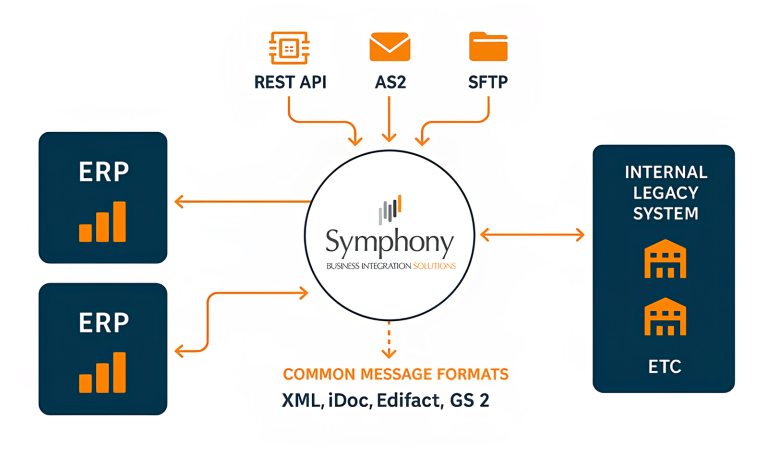
When it comes to integrating ERP and WMS systems, businesses typically choose between EDI integration solutions and API integration solutions. Both offer distinct advantages depending on the size, scale, and requirements of your organization, and in many projects, a combination of both is used to handle different flows.
EDI Integration Solutions
Electronic Data Interchange (EDI) enables standardized data exchange between business systems. EDI integration solutions are ideal for companies with high-volume transactions involving suppliers, distributors, and partners. This method automates document exchanges—like purchase orders and invoices—without manual intervention, reducing errors and processing time.
It is especially beneficial for businesses in legacy supply chains where partners require strict EDI compliance. Adding ERP-WMS communication via EDI streamlines operations without disrupting existing partner protocols.
API Integration Solutions
APIs (Application Programming Interfaces) allow real-time data access and offer greater flexibility. API integration solutions are preferred by businesses needing dynamic workflows and up-to-date inventory visibility—for example, updating stock levels as orders are packed or shipped.
They also provide greater control, such as triggering alerts when inventory is low or automatically generating replenishment orders. Many modern platforms support REST APIs or webhooks for seamless, event-based data exchange.
Today, many organizations use a hybrid model—leveraging EDI integration solutions for batch-based communications and API integration solutions for real-time needs.
Benefits of ERP WMS Integration
The advantages of integrating ERP and WMS systems extend beyond speed and automation. Key benefits include:
- Instant access to up-to-date inventory data, shipping progress, and order status
- Automation of repetitive tasks such as order creation, picking, and invoicing
- Fewer manual errors due to synchronized, real-time data sharing
- Scalability to support business expansion and technology upgrades
- Faster decision-making through centralized data visibility
- Improved customer satisfaction through timely and accurate order fulfillment
- Lower operational costs by eliminating redundant administrative work
With ERP WMS integration, companies are better equipped to adapt to changing market conditions and rising customer expectations.
Industry Applications
ERP WMS integration is relevant across many industries. Here are a few examples of how it makes a measurable difference:
Logistics
Third-party logistics providers (3PLs) use integration to synchronize shipments, inventory, and billing across multiple clients and platforms. Faster turnaround and fewer errors lead to stronger client relationships. For 3PLs managing dozens or hundreds of customers, Integrated systems help manage multiple client workflows without data overlap or errors.
Retail & E-Commerce
For retailers, integration ensures that online orders, returns, and stock levels are always aligned. This reduces stockouts and overselling, while improving the customer experience. During peak sales events, such as Black Friday or holiday seasons, integrated systems help scale operations smoothly without manual firefighting.
Manufacturing
Manufacturers rely on ERP WMS integration to coordinate production schedules, raw material inventories, and finished goods distribution. Real-time visibility enables proactive planning and reduces downtime. For example, if raw material inventories drop unexpectedly, alerts can trigger immediate procurement replenishment or rescheduling of production runs.
In highly regulated industries like pharmaceuticals or food production, traceability is critical. ERP WMS integration ensures that every item—from raw materials to packaged goods—is tracked across its lifecycle, supporting compliance and quality control. In sectors such as automotive parts or chemical goods, the ability to trace batch or lot numbers becomes essential, and integrated systems make that traceability automatic rather than manual.
Preparing for Integration Success
A successful ERP WMS integration requires more than just technology—it demands strategic planning and execution. Here are a few best practices to guide your implementation:
- Define clear integration goals based on business outcomes
- Choose the right integration method (EDI, API, or hybrid)
- Ensure scalability for future growth and system changes
- Monitor and optimize integration performance regularly
- Prepare fallback or rollback plans in case something goes wrong
- Conduct phased rollouts rather than going “big bang” where feasible
Partnering with the right provider helps you overcome these challenges.
👉Learn how ERP WMS integration works with Symphony Business Integration to streamline your operations.
Additional tips for success include:
- Train your staff: Even the best integrations can fail if users aren’t trained. Invest time in training warehouse and admin staff to use the integrated system effectively.
- Work with experienced partners: Choose solution providers with proven experience in EDI integration solutions or API integration solutions relevant to your industry.
- Perform pilot tests: Start with a small subset of processes or one warehouse to validate the integration before scaling broadly.
Conclusion: Take the Next Step Toward Smarter Supply Chains
As supply chains grow more complex, the need for ERP WMS integration becomes essential. Businesses that align their systems can operate with greater agility, accuracy, and efficiency. Reliable integrated systems also support continuous improvement, analytics, and predictive planning.
Whether you’re in logistics, retail, or manufacturing, integration provides a strong foundation for sustainable growth. Now is the time to future-proof your operations and eliminate inefficiencies caused by disconnected systems.
👉Explore more about ERP WMS integration on our Symphony Business Integration page and start optimizing your supply chain today.