
Our Latest Thinking, Insights and Updates
Integration Tracking for Operational Control
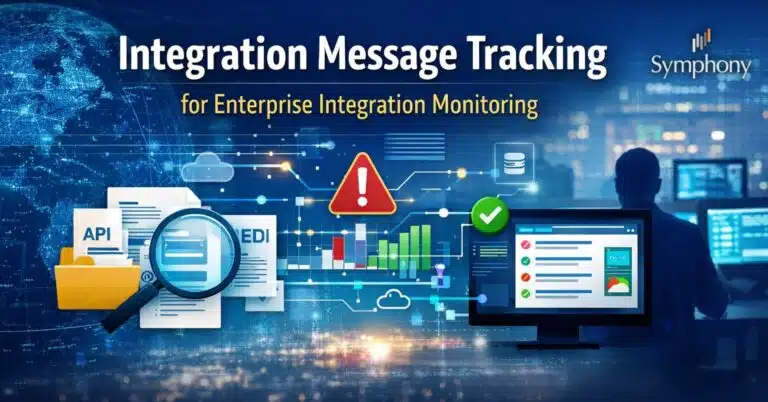
From Connectivity to Control: The Missing Layer in Enterprise Integration
Modern enterprises operate increasingly complex integration landscapes. APIs enable real-time exchanges between systems. EDI transactions facilitate structured communication with trading partners. File-based workflows synchronize data across applications, regions, and time zones.
Yet despite this connectivity, many organizations lack operational clarity once integrations go live.
Systems are connected — but not governed.
Integration message tracking provides the missing control layer that transforms technical connectivity into structured operational oversight.
Connectivity Is Not Operational Control
Integration initiatives are often measured by successful deployment. API calls execute. EDI mappings validate. File transfers complete as scheduled.
However, once in production, structured enterprise integration monitoring is frequently limited. Visibility becomes fragmented across system logs, middleware tools, and infrastructure dashboards. When issues arise, troubleshooting becomes reactive and SLA exposure increases.
Connectivity enables communication.
Operational control ensures reliability.
Without process-level monitoring and oversight, enterprise integration environments remain vulnerable to silent delays, partial failures, and performance degradation.
The Hidden Risk in Modern Integration Environments
Integration failures are rarely dramatic. More often, they emerge gradually:
- API latency increases and affects downstream processes
- EDI documents are rejected or stalled
- Scheduled files are delayed or missing
- Database dependencies intermittently fail
Without structured integration transaction tracking, these conditions may remain undetected until business impact becomes visible.
Effective integration message tracking monitors transactions from initiation through completion, capturing execution status, stage-level outcomes, and processing time. This shifts visibility from fragmented technical logs to workflow-level monitoring aligned with operational processes.
he result is faster diagnosis, improved SLA governance, and reduced operational risk.
Moving Beyond Logs to Process-Level Monitoring
Technical logs record system events. Operations require process clarity.
True enterprise integration monitoring must track defined workflows and execution stages, not just infrastructure activity. Monitoring should answer business-critical questions:
- Has the transaction completed successfully?
- Where is the delay occurring?
- Which stage failed?
- Is the SLA at risk?
This form of workflow message tracking elevates integration management from reactive support to structured operational governance.
Integration maturity is not defined by how many systems are connected, but by how clearly those connections are monitored and controlled.
Unified Monitoring Across API, EDI, and File-Based Workflows
Modern enterprises operate hybrid integration environments that combine:
- Real-time APIs
- High-volume EDI exchanges
- Scheduled or batch file-based workflows
Structured integration monitoring and alerting must operate consistently across these domains. API transaction monitoring, EDI transaction tracking, and SFTP file monitoring should not exist in isolated silos.
A unified operational framework provides centralized visibility across integration workflows, dependencies, and execution stages. This reduces fragmentation and strengthens accountability across IT and operations teams.
By consolidating monitoring into a structured control layer, organizations gain clarity across their entire integration landscape.
Intelligent Integration Exception Management
Visibility alone is insufficient without structured integration exception management.
Exception detection should identify and categorize failures, anomalies, and threshold breaches in real time, including:
- Failed or timed-out API calls
- EDI processing errors and rejections
- Missing or delayed files
- Connectivity and database transaction issues
Centralized exception tracking enables operational teams to prioritize incidents, accelerate root-cause analysis, and reduce recovery time.
Proactive monitoring strengthens SLA governance and improves integration reliability across enterprise workflows.
Scaling Governance as Integration Complexity Grows
Enterprise integration environments evolve continuously. New applications are introduced. Trading partner networks expand. Transaction volumes increase. Regulatory expectations become more stringent.
Without scalable integration message tracking, operational risk grows alongside complexity.
A mature integration framework requires:
- Process-level transaction tracking
- Consistent monitoring standards across API and EDI workflows
- Structured exception management
- Centralized visibility across environments
Operational control must scale with integration growth.
Establishing Operational Discipline Across Integration Landscapes
Symphony Business Integration Message Tracking™ supports this architectural approach by introducing structured integration message tracking and enterprise integration monitoring within the broader Symphony integration framework.
Rather than focusing solely on enabling connectivity, it emphasizes operational discipline across integration workflows. By aligning monitoring with defined processes and stages, organizations gain clearer oversight of transaction execution, exceptions, and performance.
Enterprise integration is no longer defined by connection alone. It is defined by governance, visibility, and control.
As integration ecosystems expand in scale and complexity, structured message tracking becomes a foundational capability for reliable, enterprise-grade operations.
Strengthen Your Integration Governance
If your organization is reviewing how integrations are monitored, governed, and supported across API, EDI, and file-based workflows, it may be time to evaluate whether connectivity is matched by operational control.
Explore how Symphony Business Integration Solutions provide structured integration message tracking, comprehensive enterprise integration monitoring, and intelligent integration exception management to support scalable and reliable integration environments.